

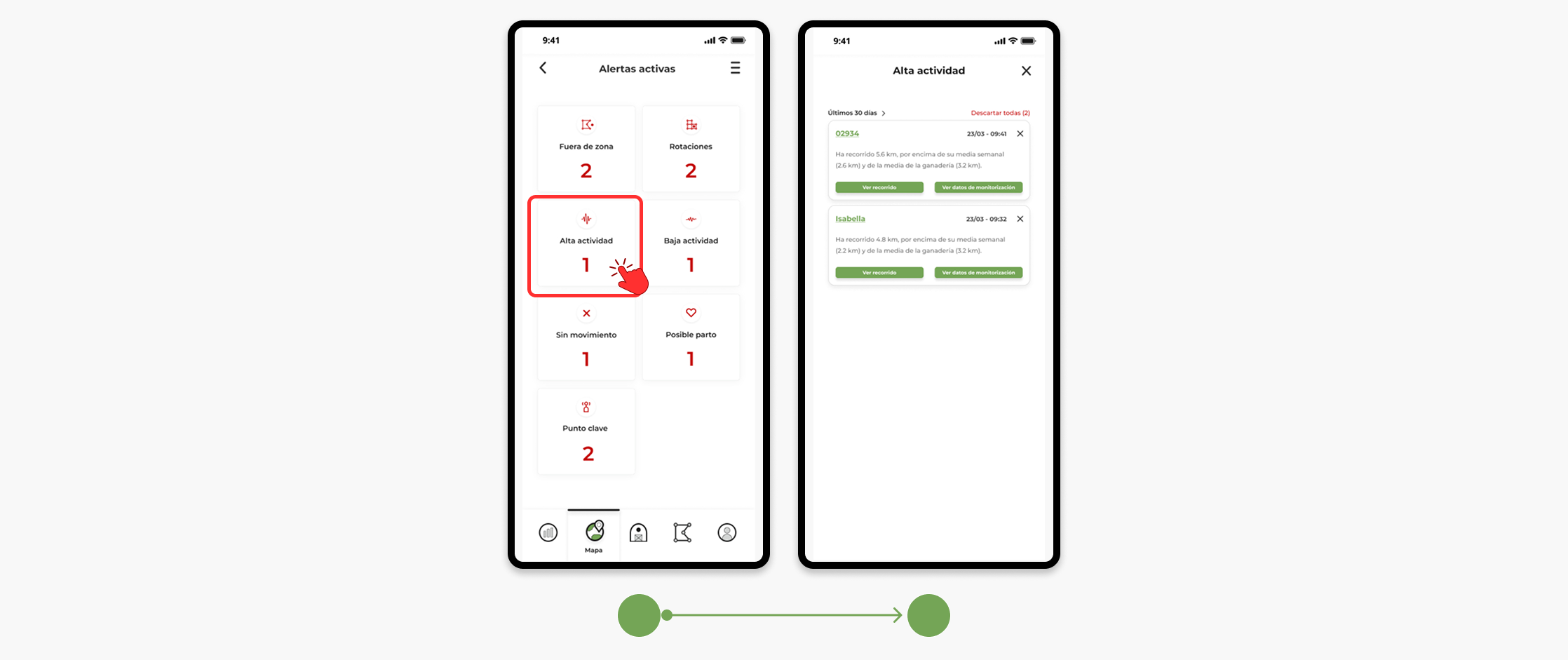
The high activity alert goes off when an animal moves much more than usual. It helps you detect situations in time that may be altering your animals' behavior.
What does it warn you about?
It's the opposite alert to the low-activity alert: instead of warning you when an animal is moving less than usual, it warns you when it's moving more.
How does it work?
Each day, the system compares the distance traveled by each animal during the last 24 hours with its own activity for the week and with that of the rest of its herd or flock that same day.
The alert is only triggered when both conditions are met at the same time:
- The animal has walked much more than its usual average.
- The animal has walked significantly more than the rest of its herd or flock.
In this way, we avoid warnings when the whole group increases its activity for a common cause, such as a change of paddock, and we focus on animals that behave differently.
What do you need to make it work well?
At least 6 days of data
To know what "a lot" means to each animal, the system first needs to know how much it is moving normally. Therefore, the device must have sent data continuously for at least 6 days. If the device is new or has been without coverage, the alert will not be activated until that history is available.
Pair the device when it is already placed on the animal
If you pair the device before placing it (for example, while it is in the office or in a vehicle), the system will record movements that do not correspond to the animal. This disrupts its usual activity and can cause false warnings or cause the alert not to go off when it should.
Why can you increase activity?
Reproduction
- Heat. The cow may be more restless, walk more, look for the bull or other cows, and mount or be mounted. For a few hours, her activity may increase considerably.
- Prepartum. In the hours before calving, the cow may be more restless, separate from the herd and look for a secluded place. It is common to observe a peak of activity followed by a descent.
- Postpartum or weaning. If the mother loses the calf, is separated from her, or the calves are weaned, she may walk more than usual while looking for her, even for several days.
- Riding or mating. If the alert is triggered on a bull, it may coincide with a period of increased activity related to the mating of females.
Food and water
- Lack of pasture, due to drought, overgrazing or the end of a rotation. The animal may have to travel a larger area to find food.
- Water problems. If a water hole dries up or breaks down, the animals can significantly increase their movements.
- Change of paddock. By entering a new area, the animals can explore the terrain and increase their activity during the first few days.
Changes in the environment or in the herd
- Scares or flights, caused by predators, dogs, people or noises.
- Theft or unauthorized herding. A quick movement in a group, especially at night, is a sign to pay attention to.
- Escaped animal or broken fence. The animal can explore outside of its usual zone. In these cases, the alert may coincide with an out-of-zone alert.
- Changes in the group, such as the entry of new animals or the arrival of the bull, which can temporarily alter the behavior and hierarchy of the group.
- Heat and adverse weather conditions. With high temperatures, animals can move more in search of shade or water and move some of their activity to the night. Storms and heavy rains can also increase movement.
To learn about the rest of the alerts in the app, see What alerts and notifications are in the app and how they work.